
Login

Measure, Understand, and Reduce your GHG Emissions

This toolkit helps Canadian organizations understand greenhouse gases (GHGs), collect and interpret GHG data, calculate a robust GHG baseline, and design practical GHG emission reduction strategies. It connects core concepts like the greenhouse effect, climate change, global warming potential (GWP), carbon dioxide equivalent (CO₂e), and GHG accounting to real-world actions that support net-zero goals.

Getting Started
Scope 2 Emissions

What are Scope 2 emissions?

Scope 2 emissions are indirect emissions that result from the generation of energy that an organization buys and uses, rather than produces directly (which would be Scope 1 emissions). These emissions are generated off-site but are consumed by the reporting organization. 
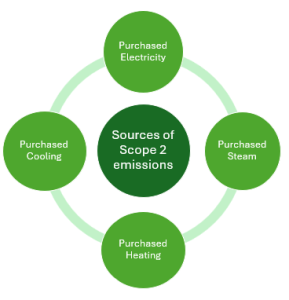
 

 Common uses of purchased energy

Purchased electricity

  • Lighting
  • Cooling equipment
  • Space heating equipment
  • Water heating equipment
  • Cooking equipment
  • Office equipment
  • Manufacturing and industrial equipment
  • Transportation equipment
  • Data centres
Purchased steam

  • Heating, drying, and curing materials in industries such as metalworking, plastics, and textiles
  • Sterilizing equipment, cooking, pasteurization, and drying food products like canned goods, dairy, and beverages
  • Sanitizing equipment, sterilizing medical products, and controlling humidity in pharmaceutical production facilities
  • Sterilizing surgical instruments, heating buildings, and generating hot water for sanitation in healthcare facilities
  • Chemical reactions, distillation, and pressure control in refining and chemical synthesis
  • Drying paper, processing wood pulp, and maintaining optimal temperatures in pulp and paper production
  • Fabric dyeing, shrinking, and pressing in textile manufacturing
  • Heating multiple buildings in a city or industrial complex through centralized heating networks (district heating systems)
  • Wort boiling, fermentation temperature control, and cleaning in beer and alcohol production
  • Metal treatment, paint curing, and cleaning in automotive and aerospace manufacturing
Purchased heat

  • Heating residential, commercial, and institutional buildings
  • Heat for manufacturing, chemical production, and refining
  • Domestic hot water in residential buildings, hospitals, and hotels
  • Pasteurization, drying, and sterilization in food and beverage processing
  • Sterilizing equipment and maintaining controlled environments in healthcare
  • Maintaining optimal temperatures for plant growth in greenhouses
  • Heated sidewalks, roads, and airport runways
  • Heating public and private pools
Purchased cooling

  • Climate control (air conditioning)
  • Process cooling (metalworking, plastics production, chemical production)
  • Refrigeration and freezing (food processors, cold storage warehouses, supermarkets)
  • Cooling servers and IT equipment (data centres)

How do Scope 2 emissions differ across Canada?

Emissions from purchased energy depend on the technologies and fuels used to create that energy. This results in significant differences in Scope 2 emissions across Canada. 

For example, Table 1 shows how much the greenhouse gas (GHG) intensity of grid-purchased electricity differs across Canada. Provinces with higher proportions of electricity generated by renewable energy technology (hydro, solar, wind, geothermal, etc.) have significantly lower GHG intensities than provinces that rely more heavily on fossil fuel-based generation technology.


Table 1

Greenhouse Gas Intensity of Grid Electricity Consumed by Province/Territory

Region Consumption Intensity in 2022
(g GHG / kWh electricity consumed) *
Manitoba 1.4
Quebec 1.7
British Columbia 15
Newfoundland and Labrador 18
Ontario 38
Yukon 70
Canada 100
Northwest Territories 190
New Brunswick 350
Prince Edward Island **
Alberta 490
Saskatchewan 670
Nova Scotia 700
Nunavut 820

* Source: Government of Canada. National Inventory Report 1990-2022: Greenhouse Gas Sources and Sinks in Canada, Part 3, Annex 13, Electricity in Canada: Summary and Intensity Tables, pp. 61-74. https://publications.gc.ca/collections/collection_2024/eccc/En81-4-2022-3-eng.pdf.

** PEI imports much of its electricity from New Brunswick. As such, the GHG consumption intensity of PEI is best reported as the same as for New Brunswick. 


Where can I find more information about Scope 2 emissions?

The Greenhouse Gas Protocol: A Corporate Accounting and Reporting Standard, Revised Edition (2004) https://ghgprotocol.org/sites/default/files/standards/ghg-protocol-revised.pdf

GHG Protocol Scope 2 Guidance: An amendment to the GHG Protocol Corporate Standard (2015) https://ghgprotocol.org/sites/default/files/2023-03/Scope%202%20Guidance.pdf 

Scope 1 and Scope 2 Inventory Guidance (US EPA) https://www.epa.gov/climateleadership/scope-1-and-scope-2-inventory-guidance 

 

Funded in part by

Reconnaissance des terres

Dans un esprit de respect, de réciprocité et de vérité, nous honorons et reconnaissons Moh’kinsstis, le territoire traditionnel du Traité 7 et les pratiques orales de la confédération des Pieds-Noirs : Siksika, Kainai, Piikani, ainsi que les nations Îyâxe Nakoda et Tsuut’ina. Nous reconnaissons que ce territoire abrite la Nation métisse de l’Alberta, la région 3 au sein de la patrie historique des Métis du Nord-Ouest. Enfin, nous reconnaissons toutes les nations qui vivent, travaillent et se divertissent sur ce territoire, et qui l’honorent et le célèbrent.

Land Acknowledgment

In the spirit of respect, reciprocity, and truth, we acknowledge that we live, work, and gather on the traditional territories of the peoples of Treaty 7, including the Blackfoot Confederacy—comprising the Siksika, Kainai, and Piikani Nations—as well as the Îyâxe Nakoda and Tsuut’ina Nations.

This land, known as Moh’kinsstis in the Blackfoot language and encompassing what is now Districts 5 and 6, is also home to the Métis Nation of Alberta, Region 3, within the historical Northwest Métis homeland.

We recognize and honour the deep connection these Nations have to the land, and we are grateful for the opportunity to share in its stewardship.

As we continue our work, we commit to learning from Indigenous knowledge systems, uplifting Indigenous voices, and fostering relationships rooted in equity, understanding, and reconciliation.

ECO Canada Logo

Site en cours de développement

Nous travaillons actuellement sur la version française du site que nous espérons lancer très bientôt!

Merci pour votre patience et compréhension pendant que nous finalisons la version améliorée du site.

Website in Development

We are working to launch the French site very soon!

 
Thank you for your patience while we finalize the new and improved version of our website.