Login

Research​

Environmental Job Market Trends​

Environmental work is everywhere. It extends far beyond traditionally green roles and industries, spanning a wide range of occupations and sectors across Canada's economy. To help employers, job seekers, educators, and policymakers better understand this evolving workforce, ECO Canada tracks labour market demand through our Job Posting Analysis (JPA) dashboard. Updated quarterly, the platform provides timely insights into online recruitment activity and trends by region, occupation, industry, and environmental specialization.

WHERE THE GREEN JOBS ARE IN 2025


Introduction to Environmental Job Posting Analysis 

Our Job Posting Analysis (JPA) helps us understand where and how environmental work is happening across Canada by examining the content of online job ads. Rather than focusing only on job titles or industries, the analysis looks at the environmental activities, skills, and knowledge described in each posting, as well as the environmental focus of the hiring organization. Job postings are also classified using Statistics Canada’s National Occupational Classification (NOC), which groups jobs by the type of work performed, and the North American Industry Classification System (NAICS), which classifies employers according to their primary business activity. Learn more about the National Occupational Classification (NOC) and North American Industry Classification System (NAICS) Canada. Changes in the number of environmental job postings (Enviro Ads) may indicate changes in overall demand for that role, shifts in job responsibilities, the skills employers are seeking, or the extent to which organizations are incorporating environmental and sustainability practices into their operations. The EnviroShare reflects the proportion of job postings that include these environmental elements, offering insight into how work is being carried out. To learn more about how we do our environmental job posting analysis, please see our Methodology.

Overall Highlights

In 2025, we examined more than 1.7 million online job postings across Canada. We identified 271,730 of these postings as environmental jobs, accounting for 16% of total online job postings. Environmental hiring was concentrated in Q2, followed by a broad slowdown through Q3 and Q4.

Quarterly Trends: How Environmental Hiring Evolved Through 2025

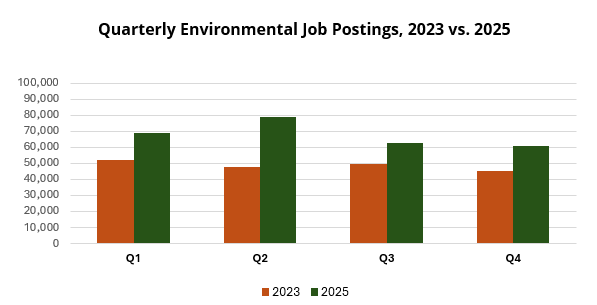
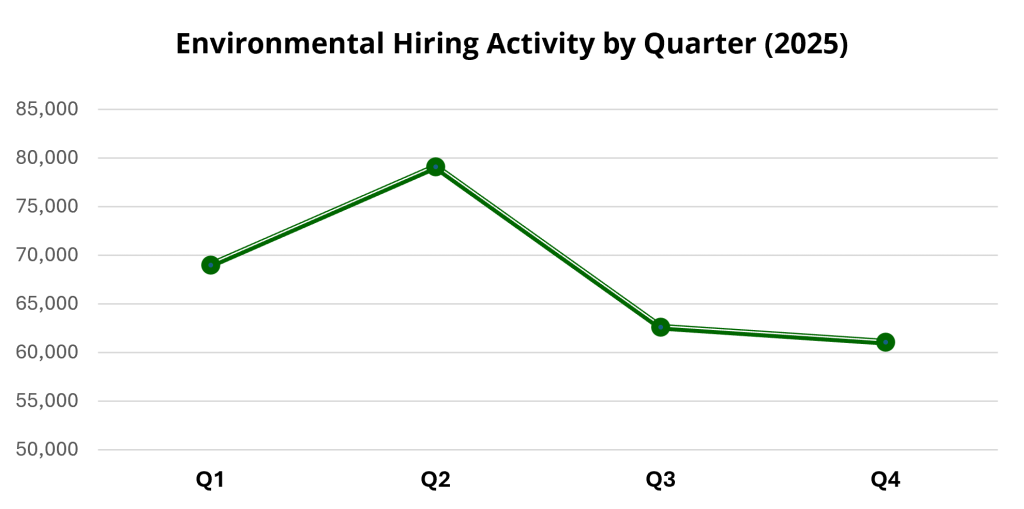
The 2025 market appears to have had a strong spring hiring cycle, followed by a broad cooling in the second half of the year. Environmental postings rose from 68,990 in Q1 to 79,100 in Q2, an increase of 15%. Activity then fell sharply in Q3 to 62,590, a 21% decline from Q2, before softening slightly again in Q4 to 61,050.

The 2025 Q2 peak was not driven by one occupation, province, industry or specialization. It appears to reflect a broader hiring cycle across the environmental labour market. The 2025 Q2 peak was visible across multiple dimensions of the data:

🟢 56% of NOCs peaked in Q2: 122 of 218 NOC codes recorded their highest level of environmental job postings in Q2.
🟢 100% of Specializations peaked in Q2: Every environmental specialization reached its highest level of job postings in Q2.
🟢 77% of Provinces and Territories peaked in Q2: 10 of 13 provinces and territories recorded their highest level of environmental job postings in Q2.
🟢 NAICS-wide peak in Q2: Total environmental job postings across industries reached their highest level in Q2.

The year-end slowdown was broad, but it did not reflect a disappearance of demand
The late-year decline should be framed as a cooling in posting activity, not a collapse in environmental demand. The market remained large, but hiring intensity eased after the Q2 peak.  

The industry mix centred on infrastructure and implementation in 2025

At the industry level, 2025 was heavily concentrated in professional services, manufacturing, construction and remediation-related services. Together, the top five NAICS sectors accounted for 58% of environmental postings in 2025. The 2025 environmental job market appears implementation-heavy. It is closely tied to consulting, engineering, construction, manufacturing, waste, remediation and infrastructure delivery.

The largest 2025 NAICS sectors were:
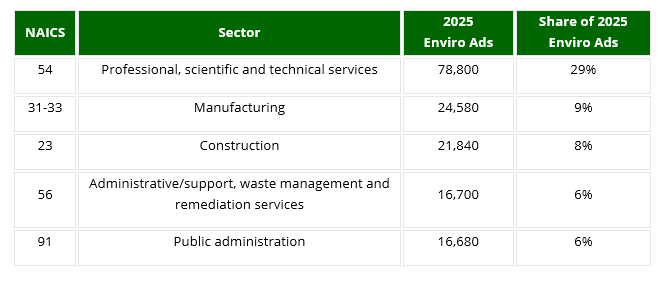
The picture changes when looking at EnviroShares, which measures the proportion of environmental jobs within an industry. In 2025, the sectors with the highest environmental shares were waste management and remediation services (65%), heavy and civil engineering construction (60%), utilities (54%), and mining, quarrying, and oil and gas extraction (51%) had the highest environmental job concentrations. These sectors did not produce the largest number of postings, but environmental roles made up a large share of their hiring activity.

High-volume sectors and high-intensity sectors are not the same. Professional services dominates by volume, while remediation services, utilities and mining stand out because environmental roles are deeply embedded in their hiring mix.

Environmental hiring demand in 2025 was broad-based, but concentrated in a relatively small number of occupations

Environmental demand spanned a diverse range of occupations in 2025, with the top 10 NOC codes accounted for 30% of environmental postings, while the top 20 accounted for 46%. This means environmental work spans many occupations, but a relatively small group drives nearly half of demand.

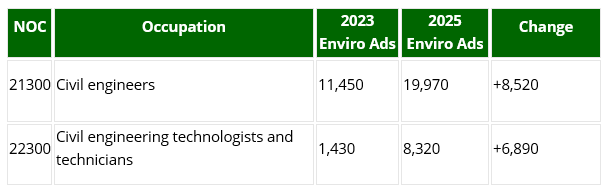
Civil engineers recorded the highest number of environmental job postings (19,970), followed by computer and information systems managers (8,920) and general building maintenance workers (8,880). This suggests that the environmental labour market is not limited to explicitly “green” job titles. It also depends heavily on infrastructure, facilities, engineering management, Information and Communications Technology (ICT), construction, operations and technical implementation roles.

By EnviroShare, civil engineers (72%), public and environmental health and safety professionals (70%), and civil engineering technologists and technicians (70%) ranked highest. The strong EnviroShare among these occupations indicates that environmental responsibilities are deeply integrated into their work.

General building maintenance workers play an important but often overlooked role in environmental work. By maintaining heating, cooling, lighting, and plumbing systems, they help buildings use less energy and water, reducing overall resource consumption. Their day-to-day tasks—such as fixing leaks, improving efficiency, and managing waste and recycling—directly contribute to lowering environmental impacts. They also help ensure indoor air quality and safe handling of materials, which supports both environmental protection and human health. In this way, their work is essential to keeping buildings operating efficiently and sustainably. Additional information on the environmental activities of key occupations can be found here: Environmental Relevance of Selected Opportunities.


Civil engineering is the anchor occupation in 2025

Civil engineers were the single largest environmental occupation in 2025, with 19,970 postings, representing 7% of all environmental postings. Their NOC-level environmental share was 72%, meaning nearly three-quarters of civil engineering postings were classified as environmental.

Civil engineering is the backbone of the 2025 environmental labour market. The growth in both civil engineers and civil engineering technologists suggests rising demand for workers who can deliver environmental outcomes through infrastructure, water systems, site work, construction, remediation, transportation, land-use planning and climate-resilient design.

Compared with 2023, civil engineering became more prominent:

Environmental specializations highlight broad, cross-functional environmental needs
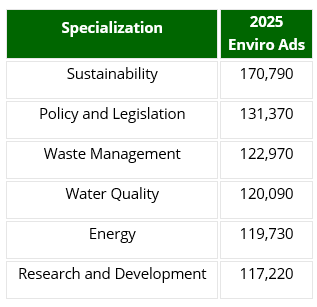
The largest specialization areas in 2025 were:

Sustainability recorded the highest number of environmental job postings in 2025, followed by Policy and Legislation, Waste Management, Water Quality, Energy, and Research and Development. Rather than being concentrated in a single technical discipline, demand was spread across a broad range of environmental functions, suggesting employers sought a mix of technical, regulatory, sustainability, and research–related expertise. All specializations peaked in Q2 before declining through the second half of the year, with Q4 levels below Q1 across every specialization. This consistent pattern points to a broad market slowdown rather than weakening demand in any one environmental domain.

Regional Highlights

Regional demand is concentrated, but environmental intensity is higher in smaller jurisdictions.

Ontario and Quebec accounted for 60% of all environmental job postings in 2025, while Ontario, Quebec, British Columbia, and Alberta together represented 88% of environmental hiring nationwide. This reflects the concentration of employment opportunities in Canada’s largest labour markets. In contrast, smaller jurisdictions recorded the highest environmental job shares, with Yukon (47%), the Northwest Territories (46%), Nunavut (32%), Prince Edward Island (31%), and Newfoundland and Labrador (26%) all well above the national average.

These findings highlight that while large provinces generate the majority of environmental hiring, smaller provinces and territories often have labour markets where environmental employment represents a proportionally larger share.

Year-over-Year Comparison: 2023 vs 2025

In 2023, environmental postings did not show the same Q2 surge. 2025 had a stronger Q2 peak, while 2023 environmental job market was more even across the year. Rather than a spring hiring peak, the 2023 pattern suggests modest fluctuation around a relatively stable baseline.

The biggest difference is the shape of the year, not the size of the market. Because the 2025 methodology changed, comparisons of absolute posting levels or environmental shares across 2023 and 2025 should be avoided. However, the quarterly patterns within each year are still informative.

The contrast is striking. In 2023, Q1 was the highest quarter and the environmental share stayed at 12% throughout the year. In 2025, Q2 was the high point, with 79,100 environmental postings, up 15% from Q1, before a sharp Q3 decline.

The 2025 environmental labour market appears more seasonal and more project-driven than 2023. The Q2 peak may reflect spring hiring, project ramp-up, field season preparation, infrastructure activity, or budget deployment cycles.

What the Findings Mean for Key Audiences

Environmental employers

Strengthen recruitment for high-demand environmental talent

Prioritize recruitment and retention of civil engineers, engineering technologists and technicians, engineering and construction managers, building operations staff, and other technical specialists. At the same time, make the environmental relevance of enabling roles, such as Information and Communications Technology (ICT), maintenance, transportation, finance, and technical sales, explicit in job postings by linking them to outcomes such as sustainability, environmental compliance, energy performance, infrastructure resilience, and climate adaptation.

Post-secondary Institutions

Embed environmental learning across non-environmental programs

Environmental hiring demand extends beyond traditional environmental occupations. Because demand spans Information and Communications Technology (ICT), construction, operations, finance, technical sales, manufacturing, public administration, and building maintenance, environmental competencies should be integrated across a wider range of programs. Examples include sustainability modules in business programs, environmental compliance in construction programs, climate risk in finance programs, and environmental data applications in computer science and Geographic Information System (GIS) programs. 

Students

Build a “technical plus systems” skill profile

Students should combine environmental knowledge with practical implementation skills. Environmental hiring demand in 2025 was concentrated in infrastructure, professional services, manufacturing, construction, waste and remediation, and public administration. Strong pathways include civil and environmental engineering, engineering technology, Geographic Information System (GIS), water and wastewater systems, environmental assessment, construction and project management, energy systems, environmental policy, data analysis, and sustainability reporting. 

Job Seekers

Position your skills around environmental implementation and outcomes

Job seekers should highlight how their experience contributes to environmental outcomes, such as infrastructure delivery, environmental compliance, energy efficiency, waste reduction, water quality, remediation, risk management, and sustainability performance. They should focus on both explicitly environmental roles and occupations where environmental impact is embedded in the work, including civil engineering, construction management, building operations, Information and Communications Technology (ICT), manufacturing, finance, technical sales, and public administration. Candidates from diverse backgrounds can strengthen their positioning by clearly connecting their skills and experience to environmental objectives and results.

Policymakers

Treat environmental workforce development as an infrastructure and implementation issue

Environmental workforce planning should be aligned with infrastructure, housing, transportation, water, energy, climate adaptation, and remediation priorities. The 2025 labour market was driven by demand in professional services, manufacturing, construction, waste and remediation, and civil engineering, highlighting the importance of technical and implementation occupations in achieving environmental outcomes. Workforce supports should strengthen talent pipelines for high-demand occupations, such as civil engineers, engineering technologists and technicians, and construction managers, while recognizing that workforce needs vary across regions and require tailored approaches.

Environmental Work Is Broader Than Green Jobs

Across all audiences, the key implication is that the environmental labour market should be understood as an implementation ecosystem rather than a narrow set of green occupations. The 2025 data points to strong demand for people who can translate environmental goals into projects, systems, infrastructure, compliance, operations, policy, and organizational change.

ECO Canada’s Environmental Job Postings Analysis is powered by
TalentNeuron.

We welcome comments, feedback, and discussion on our LMI reports. Contact
research@eco.ca.

ACKNOWLEDGMENTS

This report was funded in part by the Government of Canada’s Sectoral Workforce Solutions Program.

The ideas, views, and opinions in this publication belong to the author(s). They may not reflect those of the Government of Canada.

Our Methodology

Online job posting data have emerged as a useful indicator of hiring needs and labour market trends in Canada. Millions of job postings are advertised online each year, providing researchers with access to timely labour market information that can be used to analyze employer demand in near real time. While not all vacancies are advertised online, online job postings capture a substantial share of formal recruitment activity across the Canadian labour market. ECO Canada gathers and analyzes trends within the green economy to provide up-to-date, relevant, and credible information and insights on Canada’s environmental workforce. Our Job Posting Analysis (JPA) presents a snapshot of online recruitment activity and trends for Canadian environmental workers. Data and insights include numbers of environmental online job ads by region, occupation, industry and environmental specialization, relative to all online job ads across the country over time.  Canada’s environmental workforce is spread throughout industries and occupations. Because of this, it is not possible to directly gather data on the environmental workers using standard employment data classifications, such as the National Occupational Classification (NOC) or North American Industry Classification System (NAICS) Canada. In response to this challenge, ECO Canada has developed a proprietary method for identifying environmental job vacancies in Canada.

Labour Market Information Publications 

Job Posting Analysis reports inform environmental job opportunities in Canada, the types of jobs being posted, and the occupations and skills that are in the greatest demand. With this information, our stakeholders can identify trends, gaps and opportunities for environmental workers and support the development and maintenance of a qualified and productive workforce. 

Though informative on its own, this JPA report focuses on only one part of ECO Canada’s approach to understanding the job market for environmental workers. We also publish labour demand and labour supply outlook reports to estimate of the size of Canada’s environmental workforce by region and occupation, based in part on the EnviroShare derived from JPA. 

Our complete report collection is available at eco.ca/labour-market-research/our-reports/. 

ACKNOWLEDGEMENTS

This report was funded in part by the Government of Canada’s Sectoral Workforce Solutions Program.

The ideas, views, and opinions in this publication belong to the author(s). They may not reflect those of the Government of Canada.

Career Resources

ECO Canada gathers and analyzes skills and labour market trends within the environmental workforce to provide up-to-date, relevant data and insights for policy, business and educational purposes. Our reports support our stakeholders in four key areas: (1) employers—plan and attract qualified candidates, (2) individuals—prepare for and build their environmental careers, (3) governments—develop programs and update policies, (4) educators and trainers—adapt their offerings to prepare the workforce that is and will be in demand. 

Environmental employment in Canada is projected to grow by 9% by 2033, creating approximately 136,300 new jobs. In addition to these new opportunities, an estimated 344,200 positions will become available as workers retire over the coming years. Together, job growth and retirements are expected to generate approximately 480,500 environmental job openings by 2033. With nearly three-quarters of these openings resulting from retirements, significant career advancement opportunities are expected for both current and future environmental workers. 

Our organization responds to labour market needs through the development of human resource tools for employers, the accreditation of post-secondary environmental programs, the delivery of employment programs for students and graduates, and the certification and training of environmental professionals. 

Discover key resources ECO Canada has developed to support the sustainability of Canada’s environmental workforce. 

ACKNOWLEDGEMENTS

This report was funded in part by the Government of Canada’s Sectoral Workforce Solutions Program.

The ideas, views, and opinions in this publication belong to the author(s). They may not reflect those of the Government of Canada.

Frequently Asked Questions

Online job postings provide timely, detailed estimates of the number and distribution of job vacancies. Millions of jobs are posted online by employers in Canada. ECO Canada publishes Job Posting Analysis (JPA) reports to help describe the state of Canada’s environmental labour market within a given period and over time.

1) What does online job posting data tell us about the labour market? Online job posting data have emerged as a useful indicator of hiring needs and labour market trends in Canada. Millions of job postings are advertised online each year, providing researchers with access to timely labour market information that can be used to analyze employer demand in near real time. While not all vacancies are advertised online, online job postings capture a substantial share of formal recruitment activity across the Canadian labour market. ECO Canada’s Job Posting Analysis (JPA) reports use this data to describe the state of Canada’s environmental labour market within a given period and over time.
2) How representative are online job postings of the Canadian environmental labour market? Online job postings provide unique insights on employment opportunities and skills requirements sought by employers. However, some caution is required when interpreting job posting data. Online job postings are often skewed towards professional and service sector occupations and may underrepresent trades and other manual labour professions.

3) What will I learn from ECO Canada’s JPA reports?
The JPA report is a resource for those interested in understanding environmental job opportunities in Canada, the types of jobs being posted, and the occupations and skills that are in the greatest demand.  With this information, our stakeholders can identify trends, gaps and opportunities for environmental workers and support the development and maintenance of a qualified and productive workforce. ECO Canada aims to help government, academia, environmental employers and workers benchmark and analyse trends in the environmental job market and assess current and future workforce needs.

4) How often is the JPA report updated?

ECO Canada updates job posting data on a quarterly basis. Information presented in the report spotlights the distribution of job vacancies across Canada and highlights national and regional trends for industries, occupations and specializations that compose the environmental workforce.

5) Where does job posting data come from?
Our research uses a dataset compiled by TalentNeuron, which includes job ads from sources such as Monster.ca, the Canada Job Bank, Emploi-Québec, WorkBC, BCJobs.ca, JobServe, ECO Job Board, as well as the job boards of individual companies. The TalentNeuron dataset includes information such as the full text of the job description (in French or English), job type (full-time versus part-time), location, level of desired education, and additional skills or certifications required for the position. TalentNeuron analyzes posting data to identify unique positions by filtering out duplications across multiple sites. If key components of information are missing, these data were not included in the analysis.

6) What is an environmental worker?

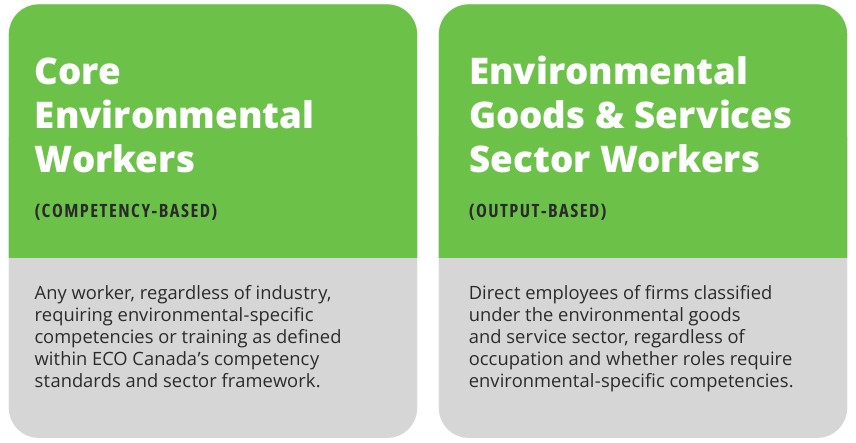
ECO Canada describes an environmental worker as those employed within environmental goods and services companies regardless of the occupation and those with specialized environmental competencies regardless of the industry employer.

7) What is NOC?

The National Occupational Classification (NOC) is Canada’s standard for describing occupations. Both core environmental and environmental goods and services sector employment are spread across industries and occupations and do not align precisely with traditional taxonomies such as NOC. ECO Canada maps environmental job ads to each NOC using the information provided by employers for vacancies such as job title, main duties and educational requirements. With this approach, ECO Canada can analyze the demand and supply for the workforce, which would otherwise be unavailable.

8) What is an EnviroShare?

ECO Canada coined the term EnviroShare to present the proportion of environmental job ads as a percentage of total online job ads. The EnviroShare method accounts for shifts in occupational and geographical distribution to permit a more granular approach to analyzing job vacancies in Canada.

While an occupation might rank high in the number of environmental job ads, its EnviroShare might be higher or lower compared to the national average. Determining the number of online job ads that are classified as environmental is one measure of the JPA. Analyzing the occupations by their EnviroShare presents a different perspective.

9) What is NAICS?

The North American Industry Classification System (NAICS) is Canada’s standard for categorizing industries.  This system has been developed and adopted by Canada, Mexico and the United States, to allow for comparison among the three nations. Environmental employment is spread across industries and does not align precisely with traditional taxonomies such as NAICS. ECO Canada maps environmental job ads to each NAICS using the information provided by employers in their job postings.

10) What is a Specialization?

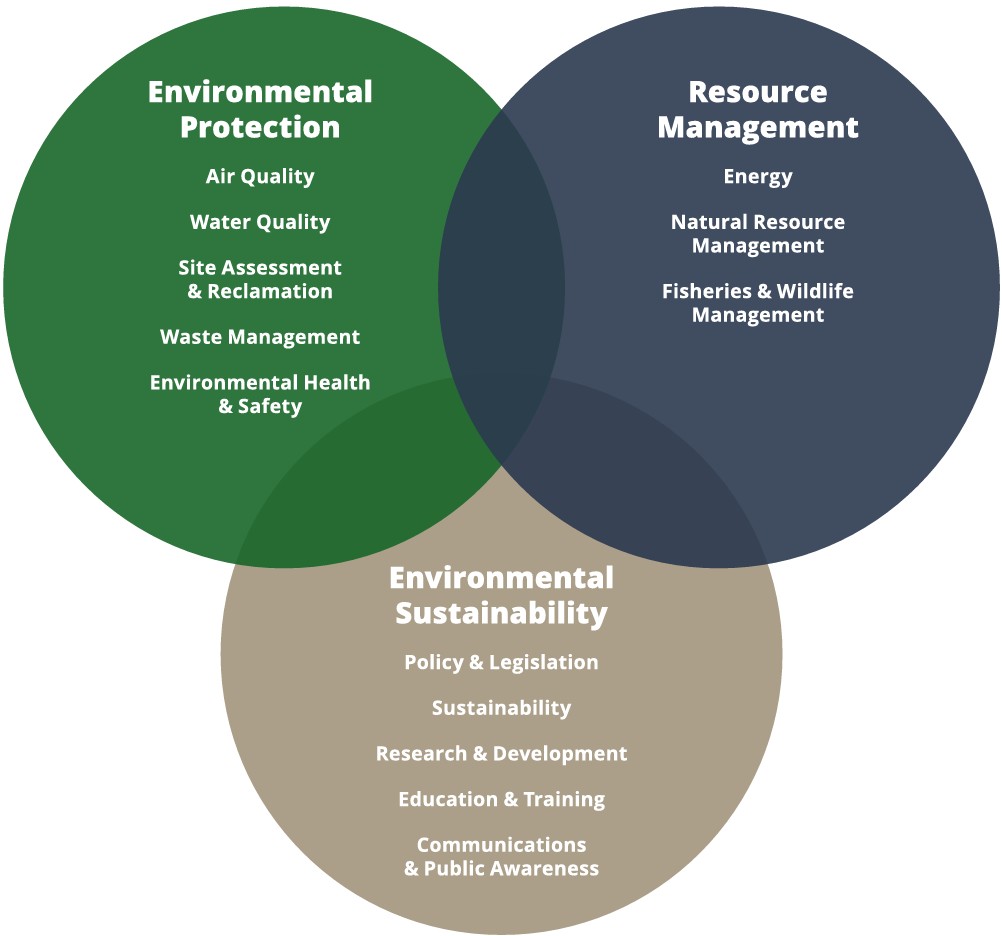
ECO Canada’s sub-sector model segments the workforce into areas related to protecting, managing and sustaining the environment. Environmental employment involves the performance of activities that seek to manage sustainable use of resources, assess or minimize environmental impacts, and maintain or restore ecological integrity of the environment. These activities relate to planning, implementing and managing environmental initiatives, programs, products or services, and developing and disseminating environmental knowledge and awareness. In practice, most environmental professionals specialize within more than one of the 14 diverse sub-sectors. ECO Canada develops National Occupational Standards for each of these environmental specializations and has defined 332 technical competencies to guide career development.
ACKNOWLEDGEMENTS

This report was funded in part by the Government of Canada’s Sectoral Workforce Solutions Program.

The ideas, views, and opinions in this publication belong to the author(s). They may not reflect those of the Government of Canada.

STUDENT WORK PLACEMENT PROGRAM
EMPLOYER APPLICATIONS OPEN

Build your team.
Support student talent.

Hire a post-secondary student for a meaningful work placement and receive financial support toward eligible wages.

$5,000
Up to $5,000 in wage support

Get reimbursed for up to 50% of eligible student wages.

6–16 weeks Placement length
180+ hours Per placement
Canada-wide Eligible employers

Eligible employers include Canadian-owned businesses, Canadian subsidiaries, and non-profits of all sizes. Placements must relate to the student's post-secondary program in STEAM or Business.

Apply as an Employer

Support is subject to program eligibility, available placements, and approval.

Contact Us
This field is for validation purposes and should be left unchanged.
Name

Reconnaissance des terres

Dans un esprit de respect, de réciprocité et de vérité, nous honorons et reconnaissons Moh’kinsstis, le territoire traditionnel du Traité 7 et les pratiques orales de la confédération des Pieds-Noirs : Siksika, Kainai, Piikani, ainsi que les nations Îyâxe Nakoda et Tsuut’ina. Nous reconnaissons que ce territoire abrite la Nation métisse de l’Alberta, la région 3 au sein de la patrie historique des Métis du Nord-Ouest. Enfin, nous reconnaissons toutes les nations qui vivent, travaillent et se divertissent sur ce territoire, et qui l’honorent et le célèbrent.

Land Acknowledgment

In the spirit of respect, reciprocity, and truth, we acknowledge that we live, work, and gather on the traditional territories of the peoples of Treaty 7, including the Blackfoot Confederacy—comprising the Siksika, Kainai, and Piikani Nations—as well as the Îyâxe Nakoda and Tsuut’ina Nations.

This land, known as Moh’kinsstis in the Blackfoot language and encompassing what is now Districts 5 and 6, is also home to the Métis Nation of Alberta, Region 3, within the historical Northwest Métis homeland.

We recognize and honour the deep connection these Nations have to the land, and we are grateful for the opportunity to share in its stewardship.

As we continue our work, we commit to learning from Indigenous knowledge systems, uplifting Indigenous voices, and fostering relationships rooted in equity, understanding, and reconciliation.

ECO Canada Logo

Site en cours de développement

Nous travaillons actuellement sur la version française du site que nous espérons lancer très bientôt!

Merci pour votre patience et compréhension pendant que nous finalisons la version améliorée du site.

Website in Development

We are working to launch the French site very soon!

 
Thank you for your patience while we finalize the new and improved version of our website.